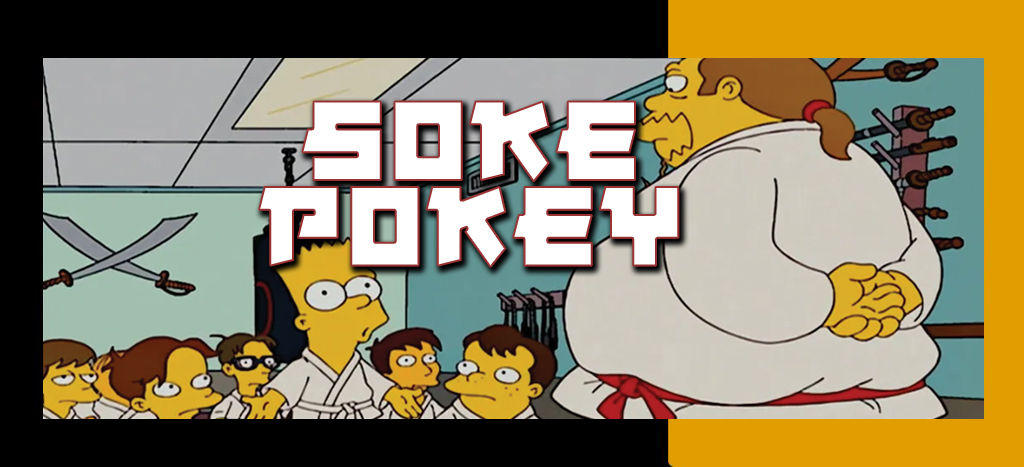
The Sōke Pokey 宗家
Soke Pokey Disclaimer:
I went back and forth on publishing this piece. In the martial arts world, it’s often considered taboo to question authority. I’m not targeting anyone in particular, but I’m confident many readers will recognize the trend.
In the words of Abraham Lincoln:
“Character is like a tree and reputation like a shadow. The shadow is what we think of it; the tree is the real thing.”
So be mindful of the shade you cast.
You put your right punch in,
you put your left kick out,
you put your right block in,
and shake it all about…
Ah, the classic participation dance—where simply being a Sensei just isn’t enough.
This is a lighthearted look at the thousands of “Great Glorious Grand Masters,” “Supreme Grand Masters,” “Eternal Masters,” “Ultimate Masters,” Sultans, Luminaries, Grand Poohbahs, and Sōke who seem to rival the omnipotent.
The self-proclaimed Mega Master can be found in every state, city, and neighborhood across America. Just let your fingers do the walking—or these days, Google them. The results will make you go hmmm:
“Master XYZ from Podunk, Iowa—undisputed, undefeated world champion”
(even though they’ve never competed outside their own zip code).
Then you see the same story in the next county… and the next… and the next. It’s mind-boggling.
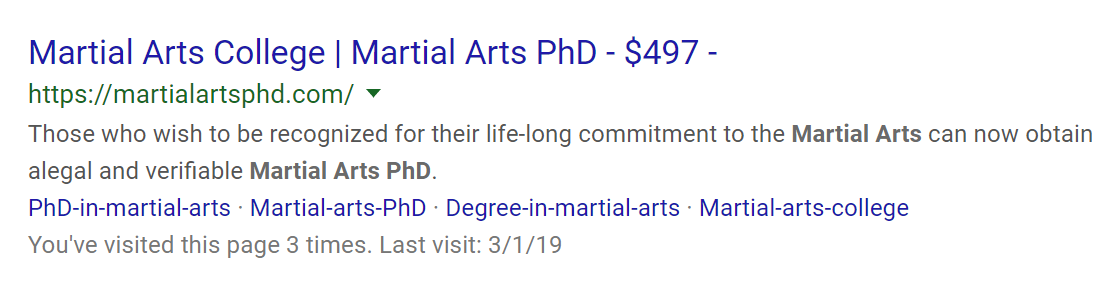
To borrow from MythBusters, parts of the martial arts industry have become a circus—chock-full of showmen promoting clown credentials: PhDs in “martial science,” grand titles, and honorary ranks handed out like candy.
While the title “Doctor” is regulated in academia, martial arts has no universal governing body—so, in many cases, we’re left relying on the honor system.
A quick search yields over 7,000,000 results for “PhD martial arts,” offering a buffet of diploma mills and questionable credentials to choose from.
I’ve been studying Shotokan karate-dō (松濤館) my entire life—43 years as of 2023—under the watchful eye of my father, who dedicated his own lifetime to the art long before me. Because of that foundation, I feel confident sharing these observations.
I remain, first and foremost, a student of the “martial way.” I don’t claim to be an expert in Japanese nomenclature, but I did study three years of Japanese in high school and two more in college, giving me a solid working understanding of the language.
Unfortunately, I’ve seen far too many egos inflated by nothing more than a quick flip through a Japanese–English dictionary and thesaurus.
That constant psychological game of one-upping the instructor next door?
I call it the Sōke Pokey.
Sōke Pokey
When you put your left arm in ? Your left arm out ?In, out, in, out ?You shake it all about ?You do the Sōke PokeyAnd you turn aroundThat’s what it’s all about
Woah-oh, the Sōke PokeyWoah-oh, the Sōke PokeyWoah-oh, the Sōke Pokey
First, instructors spin the wheel of fortune in search of an exotic-sounding title. Popular honorifics like Kyoshi and Hanshi? Too plain, apparently. Why not upgrade to Kancho, Kaicho, Shidoshi, Shoshū, or Meijin—something a little more obscure, a little more mystical. You get the idea.
Next, the “promotion” is conveniently legitimized by a cyber roundtable—an online council ready to certify greatness (for three easy payments of $199.99).
Snarky? Maybe. But with the amount of nonsense online, it practically writes itself.
You can almost hear the late-night infomercial voice:
“But wait, there’s more! You’ll receive an embroidered dragon patch and an official certificate stamped with assorted, random hanko—at no extra charge!”
Naturally, it’s oversized… perfect for a profile picture.
For a little extra coin, they’ll even throw in a Hall of Fame honor—right alongside legends like Bruce Lee. Authenticity guaranteed, notarized on “ancient” parchment from a Buddhist temple, no less.
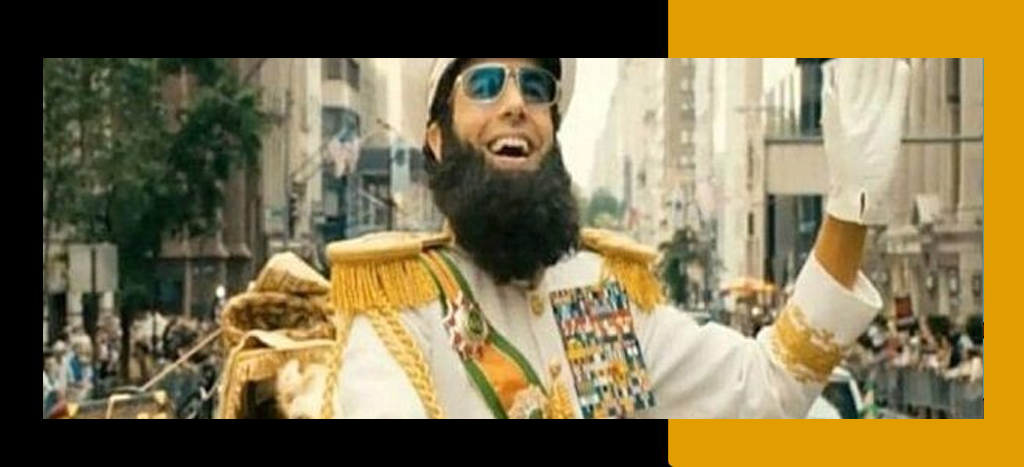
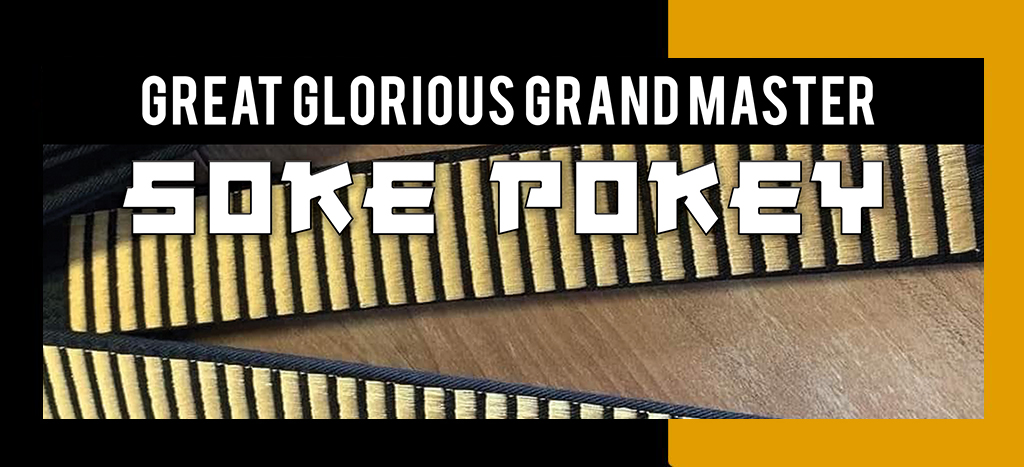
These self-appointed head honchos—rocking 13th-degree, barbershop-style belts in full muckety-muck fashion—are the embodiment of unchecked capitalism and the complete contradiction of budō.
It’s okay to chuckle—we all know the type.
FYI: Hancho (班長) is a legitimate Japanese term meaning “squad leader,” now commonly used in American jargon.
Not all egomaniacs are selling snake oil—some can actually fight. But once ego is injected, narcissistic bujutsu can become toxic. Think Cobra Kai: “Fear does not exist in this dojo.”
The antidote is budō—but even that can be imitated. Beware the charlatan who preaches humility. There is a profound difference between a martial artist and a practitioner of the martial way.
It may sound cliché, but actions speak louder than words—especially to an unsuspecting white belt who doesn’t yet know the difference. Beginners are often the easiest to sweep up into the cult mentality.
There’s nothing wrong with being proud of your dojo’s accomplishments—you should be. Just don’t fabricate them. My father taught me:
“Character is a commodity you can’t buy—you can only build it. Authentic budō is priceless.”
There are far too many self-promoted gurus who exaggerate to the nth degree. What begins as a “white belt” stretch can quickly escalate into full “black belt” hyperreality.
Most offenders follow the same M.O.: out of shape, brash, and boastful. You’ll hear stories of Shaolin monks blessing them with holy water, or claims that their system is “too deadly” for competition.
Their look? A tattered, Crayola-inspired obi that Liberace would admire, paired with a uniform covered in patches and chevrons signaling supposed eminence—yet no one has ever actually seen them perform.
Are they kuchi-bushi—“mouth warriors”—lost in delusions of grandeur? Every case is different, but their lineage is often hazy at best.
There are exceptions, of course—but if it walks and talks like a duck…
Some are harmless. Others are not.
There are also innocent casualties—students caught in second- or third-generation misinformation, inheriting diluted traditions. One can only imagine Gichin Funakoshi rolling in his grave.
Funakoshi, the father of modern karate, never obsessed over rank. Progression, to him, was a journey of self-perfection.
This isn’t to say the modern kyū/dan system is wrong—we use it. But it should never become the centerpiece of your identity. Hierarchy has its place, especially in structured schools, but only when kept in perspective.
There are legitimate Grand Masters and 10th-degree black belts—but they are few and far between. Not every McDojo headmaster qualifies.
All traditional Japanese arts—from ikebana (flower arranging) to tea ceremony—are structured and disciplined, so it’s no surprise karate followed suit. However, belts, uniforms, and ranking systems are relatively modern developments, not relics of feudal Japan.
Much of this standardization began with the Dai Nippon Butoku Kai (大日本武徳会), founded in 1895 in Kyoto under government authority. Its mission was noble: unify and legitimize martial disciplines.
In the early 1900s, the Butoku-kai introduced titles like Hanshi and Kyoshi—but these were written distinctions, not spoken titles. Traditionally, they were not used conversationally.
To put it simply: my brother-in-law Tim may be a Master Plumber—but I don’t greet him as “Master Tim.” (Though he might enjoy it.)
In Japan, referring to yourself as “Master” is a breach of etiquette. Even if earned, broadcasting it is considered impolite. The appropriate term is Sensei—a respectful, widely accepted title across professions like law, medicine, education, and martial arts.
Of course… for the insecure karate-ka, that may not sound very impressive.
And let’s not forget: the act of rei (bowing) is literally the physical expression of lowering one’s ego—the very essence of budō.
The Butoku-kai initially recognized disciplines such as jujutsu, judo, and kendo.
Jigoro Kano had already introduced the kyū/dan ranking system in 1883. Contrary to popular belief, it wasn’t entirely new—it was adapted from the ranking system used in the ancient board game Go.
By the early 1900s, the black belt (kuro-obi) and training uniform (judogi) became standard. Kano likely chose black and white for practical and symbolic reasons—possibly influenced by other Japanese sports and even philosophical concepts like yin and yang.
The popular myth of a white belt turning black from years of sweat and blood? Pure fiction. Japanese culture places a strong emphasis on cleanliness.
After the passing of Anko Itosu, Funakoshi carried on his teacher’s legacy and followed Kano’s model.
On April 12, 1924, Funakoshi awarded the first karate dan ranks to seven students in alignment with Butoku-kai standards. At the time, he himself held no rank.
He later accepted the title of Kyoshi in 1943 but never promoted anyone beyond 5th dan—including himself.
Some of his direct students, like Tsutomu Oshima, maintained this ceiling. Others, like Masatoshi Nakayama, rose to higher ranks (9th dan, later 10th posthumously).
These differing philosophies led to inevitable fragmentation, as many of Funakoshi’s students formed their own organizations and interpretations of karate.
Colored belts, often thought of as tradition, didn’t gain popularity until the 1930s, when Kawaishi Mikonosuke introduced them in Europe as a motivational system for students.
Funakoshi and Kano were educators who understood the political landscape. For their arts to grow, they had to align with the expectations of the Butoku-kai and the Japanese government.
By the 1930s, karate gained official recognition—but only after meeting certain criteria shaped by nationalism:
-
Karate was standardized as “empty hand” (空手)
-
A uniform (dōgi) and ranking system were adopted
-
A competitive (sport) element was introduced
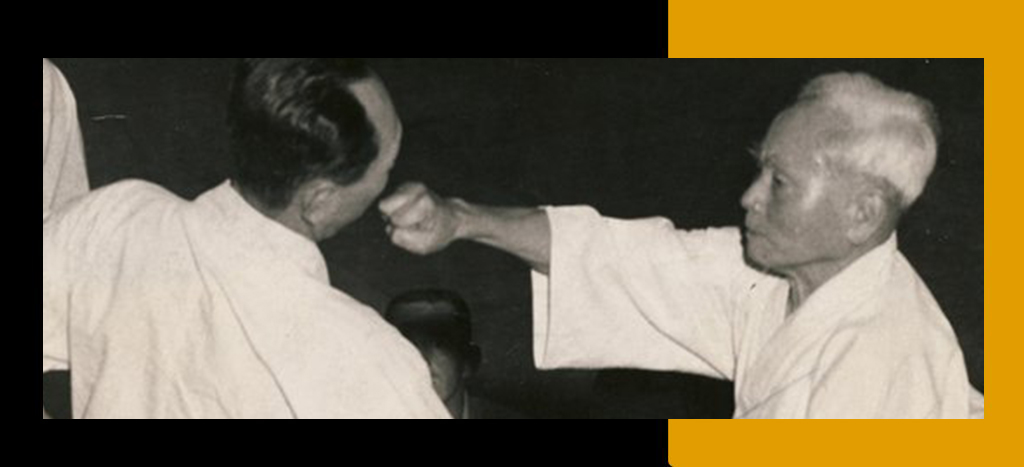
From the beginning, rank in karate has stirred mixed emotions.
One of Gojun Miyagi’s contemporaries, Chojun Miyagi, warned:
“I believe once dan ranks in karate are awarded, it will inevitably lead to trouble. The ranking system will lead to discrimination within karate, and karate-ka will be judged by their rank and not their character. It will create ‘inferior’ and ‘superior’ strata within the karate community.”
Prophetic.
Fittingly, the character “Mr. Miyagi” from The Karate Kid was inspired by this philosophy. Writer Robert Mark Kamen, a Goju-ryu practitioner, infused that mindset into one of the film’s most memorable exchanges:
Daniel LaRusso: “What kind of belt do you have?”
Mr. Miyagi: “Canvas. J.C. Penney. $3.98—you like?”
(laughs)“In Okinawa, belt mean no need rope to hold up pants.”
(then, serious)
“Karate here.” (taps head)
“Karate here.” (taps heart)
“Karate never here.” (points to belt)
“Understand?”
And for authenticity, real-life master Fumio Demura served as Pat Morita’s stunt double—bringing legitimate budō to the screen.
Then came World War II.
After the war, Douglas MacArthur dissolved all military-related organizations in Japan—including the Dai Nippon Butoku-kai. In one sweeping move, the floodgates opened.
By the early 1950s, karate associations began forming rapidly—each with its own authority to rank and promote. With no central governing body, the structure that once maintained standards was gone.
A wave of titles soon reached American shores.
It became a sea of chaos.
Pioneers like Robert Trias and Masatoshi Nakayama attempted to bring order through organizations like the USKA and JKA. They helped stabilize parts of the system—but without universal oversight, it still resembled the Wild West.
If you’ve seen Catch Me If You Can, you understand the archetype. Con men thrived in environments where verification was scarce—and martial arts, unfortunately, proved to be fertile ground.
Decades later—and thousands of organizations later—there is still no single authority. And in some corners, still no honor among thieves.
Sōke Cocktail 🥃
Directions:
Shake pride, greed, and ignorance over an ice-cold ego. Stir well. Just add students.
Sōke (宗家)—not to be confused with sake (though a sip or two may help when encountering grandstanders)—traditionally refers to the head of a family or house in Japan. In America, however, the title often raises red flags.
The pseudo-Sōke starter kit typically includes a résumé boasting multiple 10th-degree black belts, 15+ Hall of Fame inductions, and a VHS series of “secret” waza to support the brand-new style they’ve conveniently created.
To be fair, there are individuals who truly deserve the title—but you rarely hear them bragging or selling memberships. Which raises the question… should this concern them more?
Because the damage caused by counterfeit karate-ka is real. Fiction is eroding the foundation of the arts.
Sōke is closely tied to the concept of iemoto—the hereditary head of a traditional Japanese art. In Japan, the title is rare and typically reserved for very old systems (koryū).
Karate is not one of them.
So why are there so many Sōke in America?
Simple—another rung on the vanity ladder. One part ego, two parts marketing, all status. With over 300 million Americans, it’s not hard to find students willing to follow a “master” built on smoke and mirrors.
Historically, Sōke had little to do with martial arts. It was a quasi-political title, designating the head of a family, while responsibility for transmitting the art passed through generations. Over time, it extended to include family ownership of cultural assets—art, theater, poetry.
Think aristocratic dynasties—more Rockefeller than roundhouse kick.
Yet somehow, countless modern practitioners claim to have “inherited” these ancient secrets—despite no familial or cultural lineage.
So now… the sacred teachings have been passed down to Sōke Joe Sixpack of Ohio.
Sounds absurd, right?
Others take a shortcut: Shodai Sōke—“first-generation founder.”
Translation: invent a system, rearrange some kanji, and voilà—a new “ryū” is born.
It’s madness.
Even 20-somethings are getting in on it. After all, no one’s stopping them. It starts to feel like we’re watching a martial arts version of make-believe—where respect is demanded, worship is appreciated, and blind loyalty is required.
The music plays louder and louder:
You put your ego in, you pull your credibility out,
you put your arrogance in, and you shake it all about…
Some can’t take the noise. Others double down.
Pseudo-Sōke are quick to defend themselves. The go-to justification? Cross-training.
And to be clear—cross-training is admirable. Many practitioners earn ranks across multiple disciplines.
The problem arises when those ranks begin to multiply exponentially through some imaginary formula.
A little bit of everything still equals mastery of none.
Mixing systems doesn’t create a revolutionary ryū—it creates mixed martial arts. And unless you’ve had divine intervention, most “modern systems” fall under that umbrella.
Personally, I teach a unique interpretation of Shotokan. I’ve incorporated elements of Kyokushin, Capoeira, Tegumi, kickboxing, BJJ, and Korean kicking arts.
It works—for me.
But my root is still Shotokan. My title is still Sensei.
It’s not a new style—it’s a curriculum shaped by Shuhari:
Obey. Break. Transcend.
As Jesse Enkamp explains through a cooking analogy:
-
First, you follow the recipe exactly (Shu)
-
Then, you no longer need the recipe (Ha)
-
Finally, you create freely (Ri)
Congratulations—you’re a master chef.
But you didn’t invent cooking.
This misunderstanding is at the heart of the Sōke epidemic.
Evolution is encouraged in budō—but adaptation is not invention. We are not in feudal Japan, and Sōke does not mean “founder.”
If you want to be known as a creator, we already have a perfectly good word in English: founder.
The Japanese title may sound more mystical—but in most cases, it’s unnecessary.
Being a Sōke in America today is a bit like being rich in Monopoly:
Do not pass Go. Do not collect $200. Go directly to jail.
To be clear—I’m not saying all Sōke are illegitimate. The title exists for a reason, and some have earned it through authentic lineage.
But very few belong in the same conversation as Gichin Funakoshi or Jigoro Kano.
If you believe otherwise, we can agree to disagree.
For the rare, legitimate Sōke and Grand Masters—thank you. Figures like Hirokazu Kanazawa and Hidehiko Ochiai have earned their place.
Unfortunately, imposters continue to ride their coattails—and that’s a form of flattery no one needs.
As American karate continues down this slippery slope, take it all with a grain of salt.
And make no mistake—this isn’t just a karate problem. It spans taekwondo, tang soo do, kung fu, and beyond.
I’m reminded of figures like Jimmy Swaggart—individuals whose actions damaged the credibility of an entire community.
There will always be those who seek to be personalities rather than servants.
But they do not represent the majority.
Despite the noise, my faith in martial arts—and my commitment to being a Sensei—remains unchanged.
Confucius said:
“Humility is the solid foundation of all virtues.”
As a budōka, I strive to influence—not impose;
to earn—not demand;
to lead—not command.
I measure success not by the stripes on my belt, but by the integrity of my dojo.
I may have earned the title of “Master,” but being a Sensei is all I ever wanted.
An average teacher tells.
A good teacher explains.
A great teacher demonstrates.
A Sensei inspires.
If this made you question your steps… maybe it’s time to change the choreography.
It’s not too late to turn yourself around.
That’s what budō is all about.
Sincerely,
Sensei V
P.S. “Sōke” is pronounced so-kay—not so-key—if you insist on moving forward.
It’s not surprising, though. One of the most mispronounced Japanese words in history is karate. We’re all guilty of saying kuh-rah-dee, when the correct pronunciation is kah-rah-tay. At this point, the mispronunciation has practically become accepted colloquial slang.
Read my previous article:
“Martial Wayist” (insert hyperlink)
About the Author:
Bill Viola Jr. is an Amazon best-selling author and the creator of the award-winning Sensei Says® life-skills curriculum. He experienced the “Golden Era” of MMA firsthand—his father, Bill Viola Sr., is credited as a co-creator of modern mixed martial arts in 1979.
His book Godfathers of MMA inspired the critically acclaimed SHOWTIME film Tough Guys, where he served as a producer alongside an Academy Award–accredited team.
The Viola family owns and operates Allegheny Shotokan Karate in Pittsburgh, Pennsylvania, celebrating over 50 years of tradition (1969–2019). He currently serves as President of Kumite Classic Entertainment Corp.
Explore his latest project: CommonSensei®
📧 bill@kumiteclassic.com
🔗 Connect on LinkedIn
Read my previous article: “Martial Wayist”